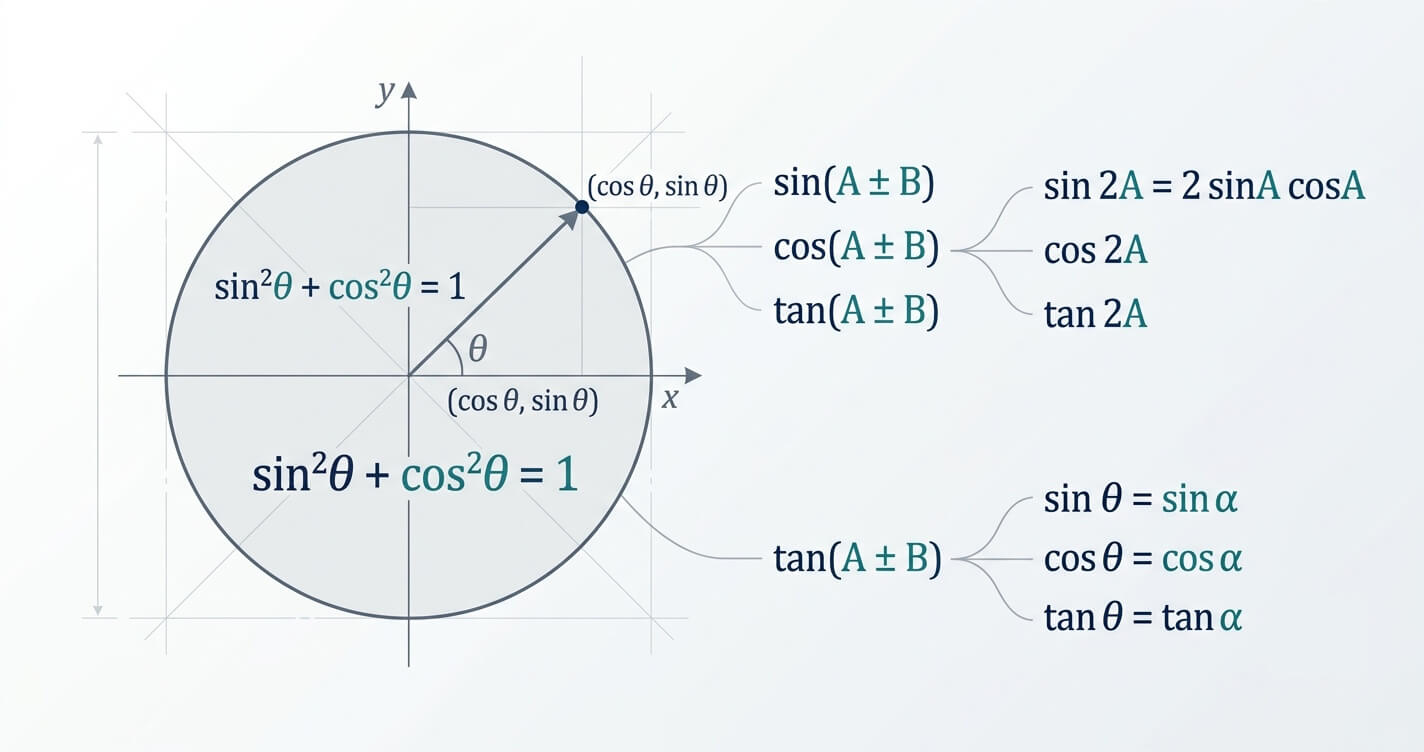
Ask any JEE aspirant which chapter they were most confident about in Class 10, and Trigonometry usually tops the list. Ask the same student in Class 11 or 12, and the answer flips completely. Nothing got harder the way Calculus or Coordinate Geometry feels harder — there's no new machinery. What changed is the sheer number of identities in play, and JEE's habit of expecting you to spot which one unlocks a problem in under ten seconds.
Trigonometry in JEE isn't conceptually deep — it's identity-dense. Students who treat it as "memorise the formula sheet" hit a wall, because that sheet has forty-plus entries and no obvious order. Students who understand why the identities exist end up needing to memorise almost nothing, because they can rebuild any identity from four or five anchor points in seconds. This is the map we give students at Exium before they touch a single practice problem — the same approach we use across the Class 11 chapter-wise strategy.
Why Trigonometry Feels Bigger Than It Is
Every trigonometric identity you'll ever need in JEE comes from combining a small number of ideas. Everything else — sum-to-product, product-to-sum, triple angle formulas, half-angle substitutions — is algebra performed on these four ideas. Once that clicks, the subject stops being a list and becomes a structure.
Idea 1
The Unit Circle
The definition sine and cosine actually come from — motion around a circle, not ratios in a triangle.
Idea 2
The Pythagorean Theorem
Applied to a point on the unit circle, this is the source of every Pythagorean identity.
Idea 3
Adding Two Angles
What happens when you combine two rotations — the compound angle formulas, and everything built on them.
Idea 4
Scaling an Angle
Doubling, halving, or tripling an angle — double, triple, and half-angle formulas fall out of this directly.
The Unit Circle: Why Trigonometry Isn't Really About Triangles
Most students carry their Class 10 definition of sine and cosine — ratios of sides in a right triangle — over from the Class 10 to Class 11 transition into JEE prep, and it quietly becomes a liability. A right-triangle ratio only makes sense for angles between 0° and 90°. The moment a problem asks for sin 150°, cos 210°, or sin(−45°), the triangle picture breaks down, and students fall back on memorised sign rules (ASTC and similar) instead of understanding what's actually happening.
The fix is to stop thinking of sine and cosine as triangle ratios altogether and start thinking of them as circular functions — functions defined by motion around a circle.
The definition: take a circle of radius 1 centred at the origin. Start at the point (1, 0) and sweep counter-clockwise through an angle θ (measured in radians). Wherever you land, that point's coordinates are (cos θ, sin θ), by definition. tan θ is just the slope of the line from the origin to that point (sin θ / cos θ), and the reciprocal functions follow the same way.
This single shift resolves almost everything students find confusing about the chapter:
01
Angles beyond 90° stop being a special case
There's nothing unusual about 150° or 210° or 750° — you just keep sweeping around the circle, past one full revolution if needed.
02
Signs in each quadrant become obvious, not memorised
sin θ is the y-coordinate, cos θ is the x-coordinate. Read the sign off a circle you can sketch in five seconds — no "ASTC" required.
03
Periodicity is visibly true, not a rule you're told
Sweep through a full 360° (2π radians) and you land back exactly where you started. That's the entire content of sin(θ + 2π) = sin θ.
04
Even and odd symmetry becomes a mirror, not a formula
cos(−θ) = cos θ and sin(−θ) = −sin θ because sweeping backward by θ lands you at the mirror image across the x-axis.
This is also the real reason the compound angle formulas work: cos(A + B) is asking "if I sweep by angle A, then keep sweeping by another angle B, where do I end up?" — a question about combining two rotations. Once trigonometry is rotation on a circle rather than ratios in a static triangle, formulas that looked like arbitrary algebra start to look like geometry you can visualise, which is a far more durable way to hold onto them under exam pressure.
Family 1: The Foundational Identities
These aren't things to memorise — they're things to be able to derive in five seconds, because everything else depends on them.
Pythagorean identities come directly from applying the Pythagorean theorem to a point on the unit circle at angle θ, where the coordinates are (cos θ, sin θ):
- sin²θ + cos²θ = 1
- 1 + tan²θ = sec²θ (divide the first identity by cos²θ)
- 1 + cot²θ = cosec²θ (divide the first identity by sin²θ)
Notice the second and third aren't separate facts to remember — they're the first identity divided by cos²θ and sin²θ respectively. Most students memorise all three independently. You only need one.
Co-function and shift identities (sin(90° − θ) = cos θ, and similar) come from reflecting the angle across the 45° line on the unit circle. Don't memorise the sign for every quadrant separately — sketch the unit circle, locate the angle, and read the sign off the axis.
Common Mistake
Memorising sec²θ − tan²θ = 1 and cosec²θ − cot²θ = 1 as separate facts from sin²θ + cos²θ = 1. They're the same identity, just divided differently — one derivation covers all three.
Family 2: Compound Angle Formulas — The Real Foundation
If you only memorise one block of formulas properly, make it this one, because every other formula in JEE trigonometry is derived from it:
- sin(A ± B) = sin A cos B ± cos A sin B
- cos(A ± B) = cos A cos B ∓ sin A sin B
- tan(A ± B) = (tan A ± tan B) / (1 ∓ tan A tan B)
Here's what most students never get told: you don't need to separately learn double angle, triple angle, or half angle formulas. They're all compound angle formulas with B set equal to A (or A/2).
- sin 2A = sin(A + A) = 2 sin A cos A
- cos 2A = cos(A + A) = cos²A − sin²A = 1 − 2sin²A = 2cos²A − 1
- tan 2A = tan(A + A) = 2tan A / (1 − tan²A)
Set A → A/2 in each of these and you have every half-angle formula. Set B = 2A in the compound formula and you can derive triple angle formulas the same way. This single realisation eliminates roughly a dozen "separate" formulas from what you need to actively remember.
Family 3: Sum-to-Product and Product-to-Sum
This is the family that causes the most panic in JEE Main and Advanced problems, mostly because students meet it as four unrelated-looking formulas:
- sin C + sin D = 2 sin((C+D)/2) cos((C−D)/2)
- sin C − sin D = 2 cos((C+D)/2) sin((C−D)/2)
- cos C + cos D = 2 cos((C+D)/2) cos((C−D)/2)
- cos C − cos D = −2 sin((C+D)/2) sin((C−D)/2)
These come directly from adding or subtracting pairs of compound angle formulas — they are not independent facts. If you're ever unsure of a sign in an exam, you can rebuild the one you need from the compound angle formulas in under thirty seconds. That's a far safer strategy than trying to recall which of four near-identical formulas has the minus sign.
The reverse direction — product to sum — is the same four equations read right to left. JEE loves testing whether you recognise when to go which direction: a sum of trig terms that needs factoring becomes a product; a product that's hard to integrate or differentiate becomes a sum.
Family 4: Solving Trigonometric Equations
This is where identity knowledge actually gets tested — not in isolation, but as a tool inside an equation. The recurring failure point isn't the identities; it's general solutions.
The three you must have cold:
- sin θ = sin α ⟹ θ = nπ + (−1)ⁿα
- cos θ = cos α ⟹ θ = 2nπ ± α
- tan θ = tan α ⟹ θ = nπ + α
The most common JEE trap: solving an equation, finding a valid-looking θ, and forgetting to check it against the domain restrictions introduced during the solving process — most often when you squared both sides or divided by a trig term that could be zero. Squaring can introduce extraneous roots; dividing by sin θ or cos θ can silently delete valid ones.
Seeing It Work: A Quick Example
This is what "identity recognition" actually looks like in practice — recognise the family, apply it, done.
Worked Example
Simplify: (cos 7A − cos A) / (sin 7A + sin A)
Recognise the family: the numerator is a difference of cosines and the denominator is a sum of sines — both point to Family 3 (sum-to-product), not Family 2. There's no reason to expand anything with compound angle formulas here.
Apply it: numerator cos 7A − cos A = −2 sin 4A sin 3A. Denominator sin 7A + sin A = 2 sin 4A cos 3A.
Solve: the sin 4A terms cancel directly, leaving −sin 3A / cos 3A = −tan 3A.
Three lines, no wasted algebra — because the first step was correctly identifying which family the expression belonged to, not reaching for the nearest formula.
How to Actually Make This Stick
Knowing the structure above changes how you should practice — not just what you practice.
Don't build a formula sheet of 40 entries. Build one of about 6: the Pythagorean identity, the three compound angle formulas, and the two "set B = A" and "set B = 2A" substitution tricks. Everything else, derive on paper until the derivation itself becomes automatic. In an exam, a memorised fact you're 80% sure of is more dangerous than a derivation you can rebuild with certainty.
Practice identity recognition, not identity recall. The actual JEE skill is looking at an expression and knowing which family it belongs to — is this crying out for a compound angle expansion, or a sum-to-product factoring, or a Pythagorean substitution? Timed problem sets where you only need to identify the right approach, without solving fully, build this instinct faster than slow, complete solutions.
Log your trigonometry mistakes specifically. If you're using the error log method we've written about before, give trigonometry its own section — the mistakes here are rarely conceptual and almost always mechanical (sign errors, forgotten domain restrictions, wrong quadrant). Those patterns are exactly what an error log is built to catch.
Where Trigonometry Shows Up Later
One more reason to get this chapter genuinely solid rather than "exam-ready": trigonometric substitutions and identities resurface constantly in Coordinate Geometry (parametric forms of conic sections), Calculus (a huge fraction of tricky integrals are solved via trig substitution), and Complex Numbers (De Moivre's theorem is trigonometry in disguise). Time spent building real fluency here pays off across the rest of the JEE Maths syllabus, not just in the trigonometry questions themselves.
Key Takeaways
- Four ideas explain the whole chapterThe unit circle, the Pythagorean theorem, adding two angles, and scaling an angle — everything else is algebra performed on these.
- Compound angle formulas are the foundationDouble, triple, and half angle formulas are all special cases of them, not separate facts.
- Sum-to-product isn't four independent formulasThey're compound angle formulas added or subtracted — rebuild them if you're unsure, rather than guessing a sign.
- Recognition beats recallThe real JEE skill is spotting which identity family a problem belongs to, not recalling formulas faster.
- Most equation-solving errors happen at the last stepAlways check for roots introduced or lost by squaring or dividing by a trig term.
Build Real Trigonometry Fluency at Exium Classes
Identity maps before problem-solving. Structured practice. Personal attention. On-campus in Bokaro or live online — your choice.
Reserve Your Seat →Frequently Asked Questions
Not conceptually — most of the difficulty is that it's identity-dense rather than idea-dense. Students who memorise formulas in isolation struggle; students who understand that nearly every identity derives from the unit circle and the compound angle formulas find it one of the more scoreable chapters in JEE Maths.