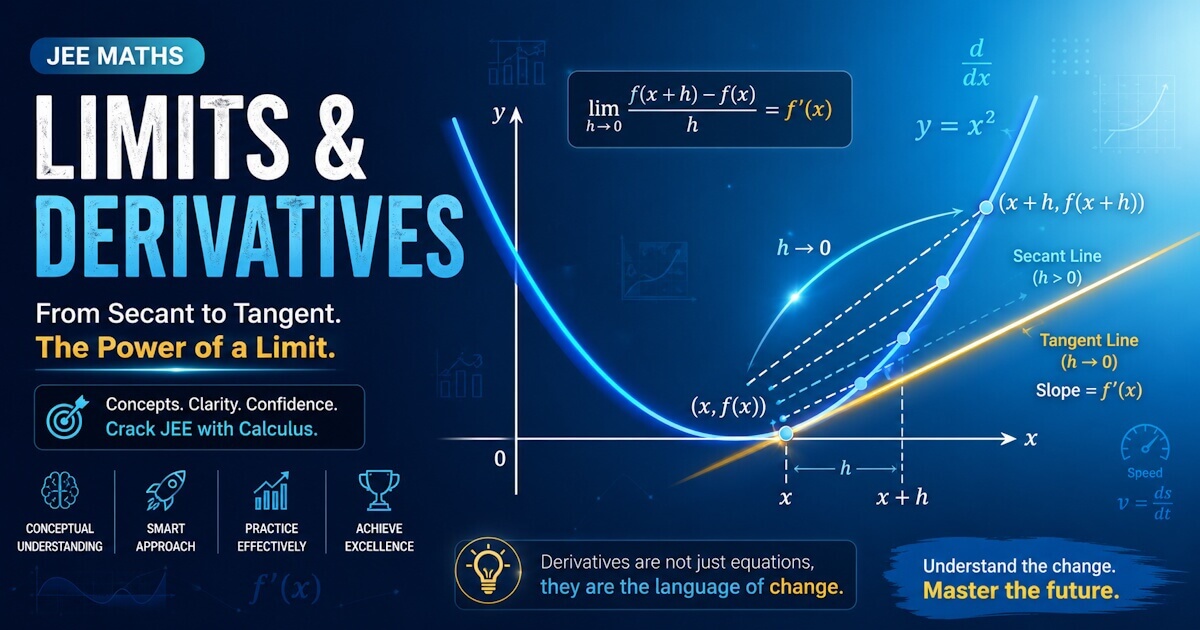
Calculus divides JEE aspirants into two groups. The first group treats it as a collection of formulas and tricks — L'Hôpital's Rule, standard limits, differentiation shortcuts — and finds that it works up to a point, then doesn't. The second group understands what a limit is, what a derivative means, and finds that almost every JEE Calculus problem becomes a variation of a picture they have already understood.
This article is about how to join the second group. Not by memorising more, but by building the geometric and physical intuition that makes the entire chapter coherent instead of a list of disconnected techniques.
If you're starting Class 11 preparation, read The Big Leap: Class 10 to Class 11 Transition.
Why Most Students Struggle with Calculus
The struggle is almost never about intelligence. It is about the order in which things are taught.
Most students encounter limits for the first time as a formal definition — something about ε and δ, or a list of standard results like lim(x→0) sin x / x = 1 — before they have any visual sense of what "approaching a value" means on a graph. They learn the formulas. They practise the manipulation. And everything is fine until a question arrives that doesn't look like any formula they've seen.
The pattern that kills Calculus scores
- Memorising standard limit results without understanding where they come from
- Applying L'Hôpital's Rule without checking if the form is actually indeterminate
- Treating the derivative as a formula to be differentiated, not a rate of change to be understood
- Solving problems by pattern-matching, not by reasoning from first principles
"JEE Calculus questions are specifically designed to test whether you understand the concept — not whether you've memorised the formula."
The fix is not more practice problems. The fix is building the picture first, then letting the formulas be the language that describes what you already understand.
What a Limit Actually Is
Here is the core idea, stated as simply as possible:
A limit asks — what value does a function approach as the input gets closer and closer to some number, without necessarily reaching it?
That last part matters more than most students realise. A limit is not asking what the function equals at a point. It is asking what the function is heading towards. The function may not even be defined at that point, and the limit can still exist.
Consider the classic example: the function f(x) = (x² − 4) / (x − 2). At x = 2, this is 0/0 — undefined. But as x approaches 2 from either side, the function approaches 4. That approach is the limit. The fact that the function breaks at x = 2 doesn't change what it's approaching.
lim(x → 2) (x² − 4) / (x − 2) = lim(x → 2) (x + 2) = 4
This distinction — between the value of a function and the limit of a function — is the first conceptual gate. Students who confuse the two spend the rest of the chapter making errors they can't locate, because they are applying the wrong mental model.
The Secant Line — Where the Derivative Is Born
Before there is a derivative, there is a question that has troubled mathematicians for centuries: what is the slope of a curve at a single point?
You know how to find the slope of a straight line — rise over run, two points, done. But a curve doesn't have a single slope. Its steepness changes constantly. So how do you find the slope at a particular point on a curve?
The answer that calculus gives is brilliant in its simplicity. You start with two points. You draw the line through them — that's the secant line — and calculate its slope. Then you move the second point closer and closer to the first. As the two points approach each other, the secant line approaches the tangent line. The slope of that tangent line is the slope of the curve at that point.
This is not an abstraction. This is a geometric process you can visualise. Pick any curve. Pick any point on it. Now imagine sliding a second point along the curve towards the first. Watch the secant line rotate. Watch it settle into position as the second point arrives. That settled line — the tangent — is what the derivative measures.
The Derivative Is a Limit
Once you have the secant-to-tangent picture, the formal definition of the derivative stops being intimidating. It is just a precise way of writing the process you already understand:
f'(x) = lim(h → 0) [ f(x + h) − f(x) ] / h
Here, h is the horizontal distance between the two points. As h approaches 0, the second point approaches the first. The expression [f(x+h) − f(x)] / h is the slope of the secant line. As h approaches 0, it becomes the slope of the tangent — the derivative.
The derivative is not a new idea standing separately from limits. It is a limit. A student who understands limits visually can read this definition and immediately see the picture. A student who has only memorised formulas sees symbols.
The Conceptual Shift That Changes Everything
Here is the shift, stated directly:
Stop thinking of the derivative as something you calculate. Start thinking of it as something that describes how fast a function is changing at a point.
When you differentiate x², the answer is 2x. That is a fact. But what does it mean? It means that at any point x on the curve y = x², the function is changing at a rate of 2x. At x = 1, it's changing at rate 2. At x = 3, it's changing at rate 6. The curve is getting steeper.
Once this picture is in place, a whole category of JEE problems becomes straightforward — not because you know more formulas, but because you can read what a derivative is telling you about a function's behaviour.
The limit view
A limit describes the value a function is approaching — not necessarily reaching — as the input closes in on a point. It is the language of "nearness" made precise.
The geometric view
The derivative is the slope of the tangent line to a curve at a point — found by taking the limit of secant line slopes as the two defining points collapse into one.
The physical view
The derivative is the instantaneous rate of change. Speed is the derivative of position. Acceleration is the derivative of speed. Every rate in Physics is a derivative.
All three views describe the same object. The student who can switch between them — who can see a limit problem geometrically, or see a Physics rate-of-change problem as a derivative — is the student who scores consistently in Calculus.
What This Means for JEE Preparation
Limits and Derivatives, together with their extensions in Continuity, Differentiability, and Application of Derivatives, account for over 20% of the JEE Maths paper. This is not a topic to approach with formula sheets alone.
JEE Main
6–8 marks per paper
Questions test standard limit evaluation, basic differentiation, and conceptual applications. A student with strong intuition clears these quickly and reliably.
JEE Advanced
8–10 marks per paper
Questions test whether you understand the concept — not the formula. Unusual limit forms, geometric interpretations of derivatives, and first-principles problems appear regularly.
Physics crossover
Rates of change everywhere
Velocity, acceleration, electric field, current — all are derivatives. The student who understands calculus conceptually solves Physics problems faster and with fewer errors.
Common Mistakes and How to Avoid Them
Applying L'Hôpital's Rule Without Checking the Form
L'Hôpital's Rule applies only when the limit is in the form 0/0 or ∞/∞. Applying it to any fraction that looks complicated is one of the most consistent errors in JEE Maths. Before reaching for L'Hôpital, always verify the indeterminate form. If it isn't there, don't use it.
Confusing the Limit With the Value of the Function
lim(x→a) f(x) and f(a) are different things. A function can have a limit at a point where it isn't defined, and a function can be defined at a point but have a different limit there. Keeping this distinction sharp eliminates an entire category of continuity errors.
Differentiating Without Understanding What the Derivative Means
If a question asks whether f'(x) exists at a point, the answer is geometric: does the curve have a unique, well-defined tangent there? Sharp corners, cusps, and vertical tangents are all cases where the tangent line breaks down — and so does the derivative. Knowing the differentiation rules doesn't help if you can't visualise what differentiability requires.
Treating Standard Limit Results as Magic
Results like lim(x→0) sin x / x = 1 have derivations. Understanding where a standard result comes from tells you when it applies and when it doesn't — which is exactly the information you need when a JEE question applies it in a non-standard context.
If you are new to class 11 and wish to build a maths routine, read How to Prepare Maths for JEE from Class 11.
Your Action Plan for Calculus
- Build the picture before the formulaBefore attempting any limit problem, draw the graph. Ask: what is the function approaching? Train the visual habit first — the algebra follows naturally.
- Derive at least five standard limits from scratchsin x/x, (eˣ − 1)/x, (1 + x)^(1/x), and two others of your choice. Understanding why a standard result is true is worth more than memorising fifty of them.
- Solve 10 first-principles derivative problemsUse the definition f'(x) = lim(h→0) [f(x+h) − f(x)] / h. Do not use differentiation rules. This connects the formula to the picture and makes first-principles JEE questions straightforward.
- When you see a derivative, ask: rate of change of what?Every time you differentiate a function in any subject, name the rate. "This is the rate at which area changes with respect to radius." "This is the velocity." Keep the physical meaning alive.
- Before using L'Hôpital's Rule, verify the formMake this a non-negotiable habit. Check that direct substitution gives 0/0 or ∞/∞ before applying the rule. One check eliminates a recurring error type.
- Practise left-hand and right-hand limits separately on piecewise functionsThese are the most common trap questions in JEE Main. Approach every piecewise function by evaluating LHL and RHL independently before concluding anything about the limit.
- Link every differentiability question to geometrySharp corner → not differentiable. Vertical tangent → not differentiable. Smooth curve with unique tangent → differentiable. The geometric test is faster and more reliable than algebraic checking in most cases.
Build Calculus Intuition with Exium Classes
Concept-first teaching that traces every formula to its root. On-campus in Bokaro or live online — your choice.
Reserve Your Seat →Frequently Asked Questions
A limit asks: what value does a function approach as the input gets closer and closer to some number — without necessarily reaching it? It is the mathematical tool that lets us talk about the behaviour of a function at a point it may not even be defined at.