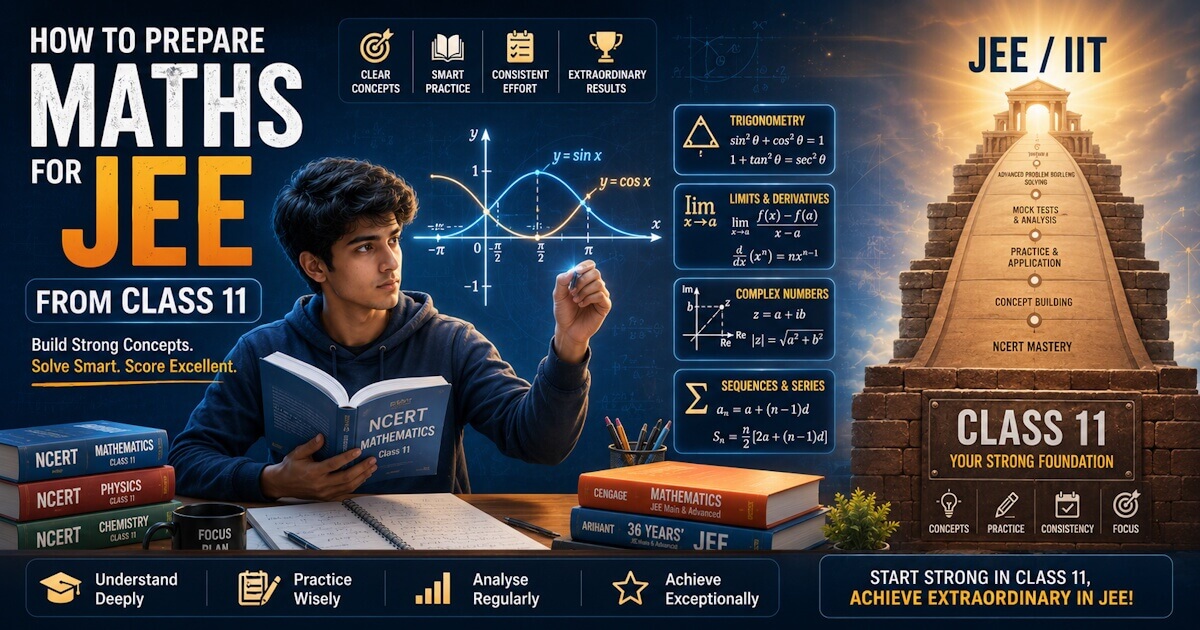
Why Class 11 is the Foundation, Not the Warm-Up
Most students make a critical mistake when they step into Class 11: they treat it as a warm-up year. "JEE is still two years away," they tell themselves. "I'll get serious in Class 12." By the time Class 12 arrives, they are staring at two years' worth of syllabus with barely twelve months to go — and Maths, of all subjects, punishes this delay the most.
Start strong, and Class 12 becomes a year of refinement. Start late, and it becomes a year of panic. The choice is made right now, in these early months of Class 11.
Why Maths Needs a Different Strategy for JEE
Physics and Chemistry have a degree of forgiveness. A formula misunderstood in one chapter can often be isolated. In Maths, everything connects. The differentiation you learn in Class 11 Calculus flows directly into the area-under-curves problems of Class 12. The trigonometric identities you skip in Class 11 come back to haunt you in inverse trigonometry and integration. The algebraic manipulation you never mastered makes complex numbers and matrices far harder than they need to be.
Maths is also the subject where marks are most binary. Either your answer is right, or it is not. There is no partial understanding that earns you a safe score. This is why Maths rewards consistent, deep preparation over last-minute cramming more than any other subject.
The good news: Maths is also the most learnable subject. Unlike raw memory-based topics, Maths rewards pattern recognition, logical thinking, and practice — all of which can be developed systematically, starting right now.
The JEE Maths Syllabus You Face in Class 11
Before you solve a single problem, know what you are preparing for. JEE Maths is spread across topics that map almost perfectly onto the Class 11 and 12 curriculum — which means your school syllabus, if followed with depth, is your JEE preparation.
The Class 11 topics that are directly tested in JEE include Sets, Relations and Functions; Trigonometry; Algebra covering Quadratic Equations, Complex Numbers, Binomial Theorem, and Sequences and Series; Coordinate Geometry covering Straight Lines and Circles; Limits and Derivatives; Probability and Statistics; and Mathematical Reasoning and Induction.
The Right Mindset: Understand the Why, Not Just the How
Top students do not memorise formulas — they understand them. This is not just an inspirational claim. It is the single biggest predictor of whether a student succeeds at JEE level or not.
Consider trigonometric identities. A student who memorises the formula:
sin(A + B) = sinA cosB + cosA sinB
will apply it when the problem looks exactly like a formula application. A student who understands why this identity is true — who has derived it, seen it geometrically, and used it in multiple contexts — will recognise it inside a complex integration problem, an equation-solving question, or a coordinate geometry proof.
JEE problems are designed to test the second type of student. The paper deliberately avoids straightforward formula applications. It rewards students who understand concepts deeply enough to see connections across chapters.
Every time you learn a new result, ask two questions: Where does this come from? and Where will this be used? Trace every theorem to its roots. This is what separates a 95 percentile from a 99 percentile performance.
Once fundamentals are strong, topics like Limits and Derivatives become much easier to approach.
Chapter-Wise Strategy for Class 11 Maths
Here is how to approach each chapter — not just what to cover, but how to think about it.
Chapter 1
Sets, Relations and Functions
Do not underestimate this chapter — it is the language of all mathematics. Spend time getting completely comfortable with domain, range, and inverse functions. This concept appears in every calculus, trigonometry, and algebra problem at JEE level.
Chapter 2
Trigonometry
Arguably the most important Class 11 topic for JEE. Do not memorise identities in isolation — derive them, then practice applying them in unfamiliar combinations. The transformation formulae (sum-to-product, product-to-sum) appear frequently. Give this chapter extra time.
Chapter 3
Complex Numbers and Quadratics
Learn the geometric interpretation — Argand plane, modulus, argument — alongside algebraic manipulation. The connection between roots of unity and geometry is a recurring JEE theme. Master the full set of conditions for roots of quadratic equations.
Chapter 4
Sequences and Series
AP, GP, and HP are standard fare. The real JEE challenge comes in mixed series and problems that combine progressions. Practice telescoping sums and method of differences — these are the techniques that separate good students from great ones here.
Chapter 5
Coordinate Geometry
Focus especially on problem-solving technique. JEE coordinate geometry problems require you to translate a geometric condition into an algebraic equation and solve — practice this translation skill relentlessly. Do not skip the family-of-circles concept.
Chapter 6
Limits and Derivatives
Your introduction to calculus. Build the right intuition behind limits before drilling techniques. Learn L'Hôpital's rule and standard limits carefully. Differentiation rules — chain, product, quotient — should become completely automatic through practice.
Chapter 7
Probability and Statistics
Probability has grown in importance in recent JEE papers. Class 11 probability — classical, conditional, Bayes' theorem — forms the base for Class 12 probability distributions. Make sure Permutations and Combinations are solid before attempting probability problems.
Building a Study System That Actually Works
Master One Chapter Before Moving On
The most common and damaging study habit is moving on before a chapter is truly understood. It feels like progress — more chapters covered — but it builds a house on sand. In Maths, incomplete chapters actively hurt you because every subsequent chapter assumes prior mastery. Stay with a chapter until you can solve problems you have never seen before, not just the ones from your notes.
Maintain an Error Log
Every mistake you make in Maths is information. Keep a dedicated notebook where you record every problem you got wrong — not just the correct solution, but why you went wrong and what thinking the correct solution required. Review this log weekly. Most students find they keep making the same category of mistakes until they actively diagnose and correct the underlying gap.
Practice Daily — Even on Busy Days
Consistency compounds in Maths far more than intensity. Forty-five minutes of focused practice every single day produces far better results than four hours on Sunday. Build the daily habit in Class 11 when the pressure is still manageable, and it will carry you through the intensity of Class 12.
Solve Problems in Timed Conditions
JEE Maths is a speed-plus-accuracy challenge. A student who can solve every problem given unlimited time will still struggle if they cannot complete the paper. From Class 11 itself, practice solving problems with a timer. Even twenty to thirty minutes of timed practice per session builds the mental discipline that JEE demands.
Balance NCERT With JEE-Level Practice
NCERT is not sufficient for JEE, but it is essential. Every NCERT example and exercise should be solved and understood before you move to JEE-level material. The transition from NCERT to JEE-level problems is sharp, and the right way to bridge it is through well-structured assignments that build difficulty progressively — not by jumping to the hardest problems immediately.
A good companion at this stage is MTG Objective NCERT at Your Fingertips — Mathematics, which provides chapter-wise MCQs mapped directly to each line of NCERT — useful for testing whether you have genuinely absorbed the text before moving to JEE-level problems.
For selecting resources, read our another article Best Books for JEE 2027.
The Class 11 Advantage: Why Starting Now Changes Everything
When you build your Maths foundation in Class 11 with genuine depth, something remarkable happens in Class 12. Topics that feel entirely new to students who skipped this work — integration, differential equations, conic sections, 3D geometry — actually feel like natural extensions of what you already know. Calculus in Class 12 is continuous with the limits and derivatives of Class 11. Probability distributions build on conditional probability. Conic sections are coordinate geometry with more structure.
Students who start in Class 11 also have something priceless: time to practice. JEE Maths is not won by understanding alone. It is won by understanding plus thousands of problems solved. Two full years of consistent practice produces a fluency that no last-minute effort can replicate.
A Word on Getting the Right Guidance
Self-study has limits. The most important thing a good teacher does is not explain the syllabus — it is show you how a mathematician thinks. When you watch an experienced teacher approach an unfamiliar problem, observe how they identify the key structure, choose the right tool, and avoid dead ends, you are learning something that no textbook can fully convey.
Equally important is the feedback loop. Knowing that your answer is wrong is not enough. Understanding how your thinking went wrong — the specific moment the approach diverged — is what produces genuine improvement. This requires someone who understands not just the subject, but the patterns of student thinking.
One of the very important step in preparing for IIT JEE is to track errors systematically. Read our article How to Analyse Your JEE Mistakes.
Your Action Plan for Class 11 Maths
- Know the full JEE Maths syllabus nowMap it onto your Class 11 chapters so you always see the larger picture while studying each topic.
- Prioritise understanding over coverageMaster each chapter before moving on. Incomplete understanding compounds into bigger gaps.
- Give extra time to Trigonometry and Coordinate GeometryThese are the highest-yield Class 11 topics for JEE and feed into almost every Class 12 chapter.
- Practice daily — minimum 45 minutesConsistency matters far more than occasional long sessions. Build the habit now.
- Keep an error log and review it weeklyTrack not just wrong answers but why your thinking went wrong. This is where real improvement happens.
- Build speed through timed problem-solvingAccuracy without speed is not enough for JEE. Introduce timed sessions from Class 11 itself.
- Complete NCERT before advancing to JEE materialSolve every example and exercise. NCERT is the bedrock — do not skip it.
- Seek guidance that explains the whyFind a teacher who traces theorems to their roots and shows you how to think, not just what to apply.
Learn Maths the Right Way with Exium Classes
Conceptual depth. Structured practice. Personal attention. On-campus in Bokaro or live online — your choice.
Reserve Your Seat →