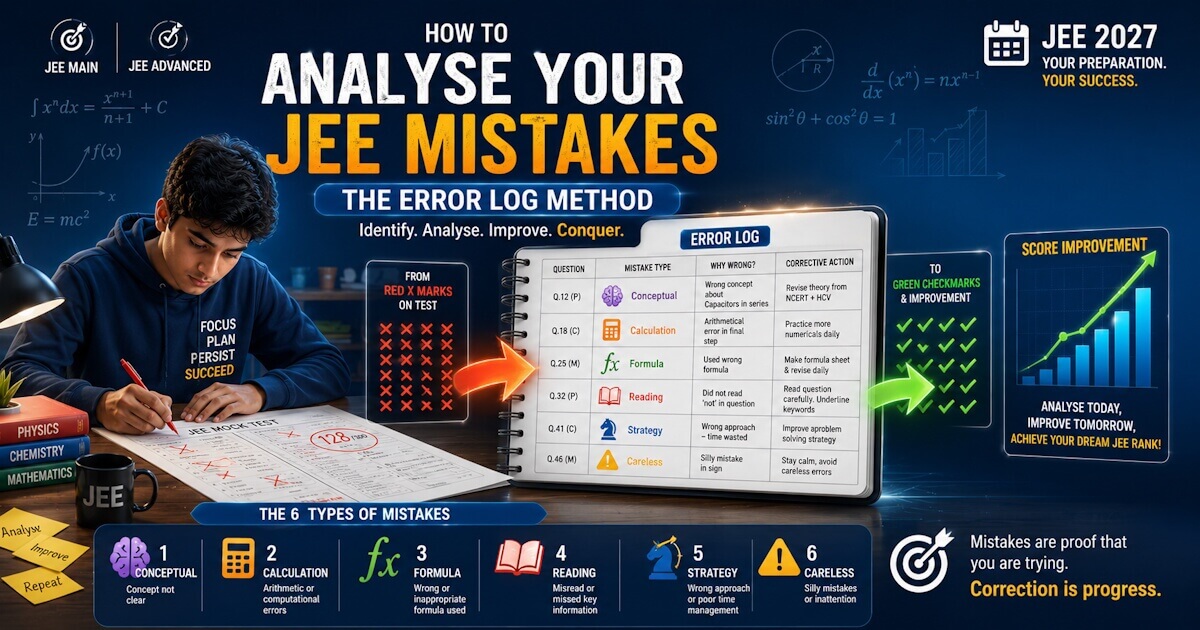
Most JEE aspirants spend their time solving more questions. Very few spend time understanding why they got the previous ones wrong.
That is the gap between a 90 percentile and a 99 percentile — not the number of chapters covered, but the quality of the feedback loop after every test. This article gives you a complete system for analysing your mistakes, building an error log, and turning each wrong answer into a targeted improvement.
Why Analysing Mistakes Beats Solving More Questions
Here is a number worth sitting with: in JEE Mains, one wrong answer costs you 5 marks relative to a correct one — 4 marks lost plus 1 mark not gained. A student attempting 70 questions with 15 wrong scores 220. The same student, with the same knowledge, attempting 60 questions with 0 wrong scores 240.
Accuracy beats volume.
Most students in the 130–200 score band are not losing marks because they haven't studied enough. They are losing marks because they keep repeating the same 2 or 3 types of errors — sign mistakes, misread conditions, formula lapses — without ever identifying the pattern.
The real reason scores stagnate
- Solving more questions without fixing recurring error types
- Looking at a wrong answer, reading the solution, and moving on without logging why
- Treating all wrong answers the same — when they have completely different causes and fixes
"The fastest score improvement rarely comes from a new chapter. It comes from fixing the same 3 errors 40 times over."
The fastest way to improve your JEE score is not always a new chapter. Sometimes it is a 30-minute review of the last mock test, done properly.
Before analysing mistakes, make sure your study resources are correct:Best Books for JEE Main & Advanced 2027.
The 6 Types of JEE Mistakes
Before you can fix a mistake, you need to classify it. Not all wrong answers mean the same thing — and treating them the same is where most mistake reviews go wrong.
Type 01
Conceptual Error
You didn't fully understand the underlying principle. You may have memorised a result without understanding when it applies. Fix: go back to the concept, then solve 5 similar problems from scratch.
Type 02
Formula or Memory Error
You forgot a formula, or remembered it slightly wrong. Fix: add it to a dedicated formula sheet and revise it daily for a week until it is automatic.
Type 03
Calculation Error
You knew the correct approach but made an arithmetic slip — wrong sign, dropped a factor, unit error. Fix: slow down, write every intermediate value, and never skip steps under pressure.
Type 04
Reading / Interpretation Error
You misread the question, missed a condition, or solved for the wrong quantity. Fix: re-read every question once after writing your answer to check you answered what was actually asked.
Type 05
Strategy / Time Pressure Error
You ran out of time, panicked, or guessed on a question you should have skipped. Fix: practise the 90-second rule — if a question isn't moving, skip it. A strategic skip costs nothing. An anxious guess costs a mark.
Type 06
Careless / Silly Error
You knew the answer, your method was correct, but a trivial slip changed the result. Fix: build a personal checklist of your most common careless patterns and run through it before marking every answer.
What an Error Log Is — And How to Build One
An error log is a written record of every question you got wrong in a mock test, DPP, or practice session — not just that you got it wrong, but exactly why, and exactly what you will do about it.
The purpose is not to feel bad about mistakes. The purpose is to find patterns. Without a log, those patterns stay invisible. You get 5 Kinematics questions wrong across three tests because of calculation errors and never notice — because you don't have the data in one place. With a log, that pattern surfaces immediately.
If you're still in Class 11 and building habits, read How to Prepare Maths for JEE from Class 11.
What to Record for Each Mistake
- Question referenceThe question number and which test or DPP it came from.
- Subject and chaptere.g. Maths — Limits and Continuity, or Physics — Rotational Motion.
- Mistake typeOne of the six categories above. Be honest — don't round everything to "Conceptual."
- What went wrongIn 1–2 sentences: exactly where your thinking diverged from the correct approach.
- Corrective actionA specific, actionable task — not "revise this topic" but "revise the squeeze theorem, then solve 3 problems from the exercise."
- StatusOpen (not yet resolved) or Fixed (you've practised similar questions and got them right independently).
Notebook vs Digital Log
A notebook works well in early preparation. As your mock test frequency increases — 3 to 4 per week — you'll accumulate 30 to 50 mistakes per week and a notebook becomes difficult to search or analyse. A Google Sheet or Notion table lets you filter by subject, sort by mistake type, and immediately see which errors are still open. That is when the error log becomes genuinely powerful: you can answer questions like "How many calculation errors do I have in Maths this month?" or "Which chapters have the most unresolved entries?"
How to Analyse a Mock Test Properly
Most students look at their score and move on. The mock test generates data. Post-test analysis converts that data into progress. Here is the sequence to follow after every test:
Step 1
Immediate gut check
Before checking solutions, go through every wrong answer and note your gut feeling: knowledge gap or silly error? This immediate reaction is often more accurate than your post-solution assessment.
Step 2
Deep review with solutions
Don't just read the solution and accept it. Trace back to exactly where your thinking diverged. Was it the first step? A formula applied in the wrong context? A sign dropped in the third line?
Step 3
Classify and log
Tag each mistake to one of the six types. Add it to your error log with a specific corrective action on the same day — the detail you remember about why you made a mistake fades quickly.
Step 4
Subject-level patterns
If 7 of your 10 Physics mistakes are from Electrostatics, that chapter needs attention before your next test — regardless of how well you feel you know it from lectures.
Step 5
Compare with previous tests
Are you repeating mistake types? A type that appears in three consecutive tests is no longer a mistake — it is a habit. It needs deliberate drilling to break, not just awareness.
Step 6
Check open entries
Before finishing your review, go through your error log from the previous test. Did you act on the corrective actions you wrote? If not, those entries stay open and go into this week's study plan.
The Weekly Review Habit
Logging mistakes is only half the job. Set aside 30 minutes every week to go through your error log. For every open mistake, ask two questions: have you revisited the concept since logging it? Have you solved at least one similar question correctly since then?
If the answer to either is no, the mistake stays open and goes into your study plan for the coming week.
Over 4–5 weeks, this weekly review shows you whether your mistake patterns are actually shifting. If the same mistake type keeps appearing, the corrective action isn't working — and you need a different approach.
A Note on Maths Specifically
For JEE Maths, the error log method has one additional use: tracking which question types tend to produce time-pressure errors.
Maths is the subject where strong students most often leave marks on the table — not from lack of knowledge, but from underestimating a question's length and running out of time in the last section. If your error log shows a consistent pattern of Strategy or Time Pressure errors in Coordinate Geometry or Calculus, that is a signal to adjust your time allocation in Maths — not necessarily to study more Coordinate Geometry.
The data in your log will tell you. You just have to collect it.
Your Action Plan
- After every mock test or DPP, classify every wrong answerUse the six mistake types. Don't skip this step — it is where the system's value is built.
- Log each mistake with a specific corrective actionNot vague. Not optional. A precise task you can start immediately.
- Set a weekly 30-minute review slotGo through all open mistakes. Act on the ones you haven't addressed. Mark Fixed only after independent success.
- Look for patterns across tests, not just within a single oneThree consecutive tests with Calculation errors in Maths is a habit to drill, not a coincidence to note.
- Use the pattern to redirect your study planIf 70% of your wrong answers are Reading errors, the fix is a reading habit — not more subject revision.
Learn Maths the Right Way with Exium Classes
Conceptual depth. Structured practice. Personal attention. On-campus in Bokaro or live online — your choice.
Reserve Your Seat →