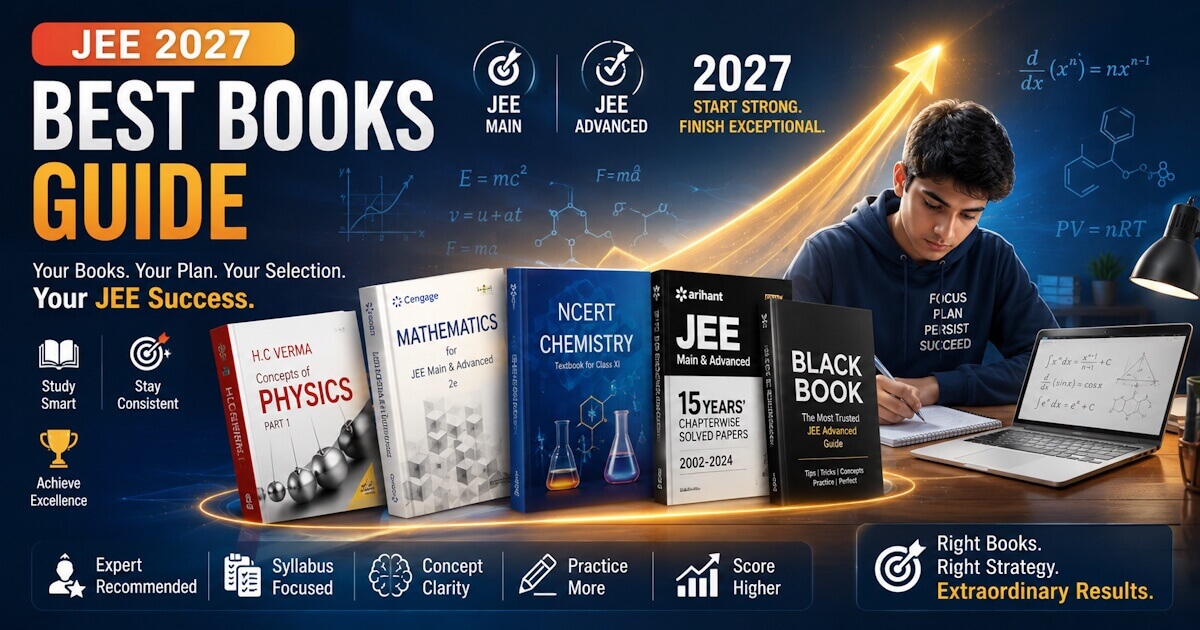
Preparing for JEE Main and Advanced is not just about hard work — it is about choosing the right resources. With hundreds of books available in the market, students often waste months jumping between options instead of going deep on a few well-chosen ones.
This guide simplifies everything. It is built on the same principle that separates high scorers from average ones: depth is more important than quantity.
The Biggest Mistake Students Make
The #1 mistake JEE aspirants make
- Collecting too many books without completing any properly
- Switching resources mid-preparation when results do not come fast enough
- Reading problems passively instead of solving them actively
"You do not need many books — you need the right books and multiple revisions."
The students who crack JEE are not the ones with the most books on their shelf. They are the ones who have solved the same five books so many times that they can anticipate question structures before reading the problem fully. Build that depth.
Mathematics — Best Books for JEE
Mathematics is the subject where most students make the coverage mistake worst. The syllabus feels large, so they spread themselves across books instead of going deep on one. The result is surface-level familiarity with everything and mastery of nothing.
Book 01
Minimal Mathematics — GB Sir
A structured question bank built on a 5-level practice system — from beginner problems through to JEE Advanced-level thinking. Bridges the gap between NCERT and coaching-level material cleanly, making it the right starting point before moving to theory-heavy books.
Start hereBook 02
Cengage Mathematics Series
Covers theory, illustrations, and graded exercises in one place. The best all-in-one for self-study — it builds concepts from scratch and progressively adds difficulty. Suitable as the primary resource from the first day.
PracticeBook 03
Arihant Skills in Mathematics
Topic-wise deep practice. Excellent for strengthening specific weak areas once you have built the conceptual base. Works well alongside Cengage or as the primary resource for students who prefer topic-wise organisation.
PracticeBook 04
Black Book (Advanced Level)
High-level problem solving for JEE Advanced. This book rewards preparation — it does not replace it. Use only after completing one main book and building genuinely strong fundamentals.
Advanced onlyStrategy: Begin with Minimal Mathematics to build problem-solving instincts from the ground up. Then move to Cengage or Arihant for full conceptual depth and graded practice. Never open the Black Book without strong fundamentals in place. Focus on solving — do not just read through the worked examples.
Physics — Best Books for JEE
Physics is the subject where conceptual clarity matters most. Students who memorise formulas without understanding their derivation consistently struggle with JEE-level problems — which are designed specifically to test whether you understand why formulas work, not just when to apply them.
Book 01
Concepts of Physics — H.C. Verma
The gold standard for JEE Physics preparation. H.C. Verma explains the intuition behind formulas, not just the formulas themselves — which is exactly what JEE tests. Every serious aspirant must complete both volumes.
Start hereBook 02
DC Pandey — Arihant Series
Structured topic-wise practice covering both JEE Main and Advanced. The graded difficulty progression makes it ideal for building speed and confidence after completing H.C. Verma.
PracticeBook 03
I.E. Irodov — Problems in General Physics
Renowned for brutally hard problems that push conceptual thinking to its limits. Not appropriate for beginners. Use selectively for Advanced preparation after mastering the above two books.
Advanced onlyFor students beginning early, also read How to Prepare Maths for JEE from Class 11.
Chemistry — Best Books for JEE
Chemistry is the most NCERT-dependent subject in JEE. Unlike Maths or Physics, where NCERT is a starting point, in Chemistry — especially Inorganic — NCERT is the primary exam resource. This makes Chemistry the subject where students most commonly over-invest in supplementary books before mastering the foundation.
Physical Chemistry
NCERT is the non-negotiable base. Supplement with OP Tandon or N Awasthi for numericals and formula-heavy practice. Focus on calculation accuracy and understanding derivations.
Organic Chemistry
NCERT covers mechanisms and foundational concepts. Use MS Chauhan for advanced practice — it is the best resource for mastering reaction pathways and named reactions at JEE level.
Inorganic Chemistry
NCERT is everything here — memorise it thoroughly. JD Lee can be used for selective deeper reading on complex topics. Revision frequency matters more than any supplementary book.
Ideal Preparation Timeline (2026–2027)
A two-year preparation window is a significant advantage — but only if each phase is used intentionally. Students who treat Class 11 as a warm-up and plan to catch up in Class 12 almost universally regret it. The timeline below treats both years as equally important.
Phase 1
Concept building
Study NCERT and core books. Understand every concept before memorising it. No shortcuts at this stage — gaps here compound into failures later.
For conceptual understanding of Calculus, also read our guide on Limits and Derivatives: Building the Right Intuition.
Phase 2
Practice
Solve standard books topic-wise. Identify weak areas and return to concept building for them. Track mistakes systematically in an error log.
Phase 3
Advanced + mock tests
Hard problems, full-length timed mock tests, and regular performance analysis. Simulate exam conditions from this phase onward.
Golden Rules for Book Selection
Commit to One Main Book Per Subject
The decision of which book to follow matters far less than the decision to follow it completely. Cengage and Arihant are both excellent for Maths. H.C. Verma and DC Pandey are both excellent for Physics. Pick one, commit to it, and revise it multiple times before considering anything else.
Revise Before You Add
Before opening a second book on any topic, ask yourself: have I revised the first one at least twice? If not, the answer is to revise — not to add more material. JEE rewards retention and fluency, and both come from repetition, not volume.
Solve, Do Not Read
Reading a worked example is not the same as solving a problem. Every time you read a solution without attempting the problem first, you are practising recognition — not problem solving. JEE tests the latter. Cover the solution, attempt the problem, then compare. This single habit makes a measurable difference in performance.
Never Switch Mid-Preparation
The most dangerous moment in preparation is when progress feels slow and a different book seems like it might be better. It almost never is. The feeling of slow progress is usually a sign that you need to revise what you have already studied — not that you need new material.
Choosing books is important, but avoiding common preparation mistakes matters too. If you're unsure whether your current strategy is working, read our guide: How to Analyse Your JEE Mistakes.
Your Action Plan for JEE 2027
- Choose one main book per subject and commit to itCengage or Arihant for Maths. H.C. Verma for Physics. NCERT for Chemistry. Do not switch.
- Complete NCERT Chemistry before any supplementary bookNCERT is the foundation — especially for Inorganic. No supplementary book replaces it.
- Solve problems — do not just read themAttempt every problem before looking at the solution. Active solving beats passive reading every time.
- Maintain an error log and review it weeklyTrack every mistake with an explanation of why your thinking went wrong. This is where real improvement happens.
- Revise each book at least twice before adding new materialTwo thorough revisions of one book will outperform a first read of three books in JEE results.
- Move to advanced books only after strong fundamentalsBlack Book, Irodov, and JD Lee are rewards for preparation — not substitutes for it.
- Begin timed mock tests in Phase 3Accuracy without speed is not enough for JEE. Build the timed practice habit early.
- Get guidance that explains the why, not just the whatFind a teacher who traces concepts to their roots and shows you how to think, not just which formula to apply.
Learn Maths the Right Way with Exium Classes
Conceptual depth. Structured practice. Personal attention. On-campus in Bokaro or live online — your choice.
Reserve Your Seat →